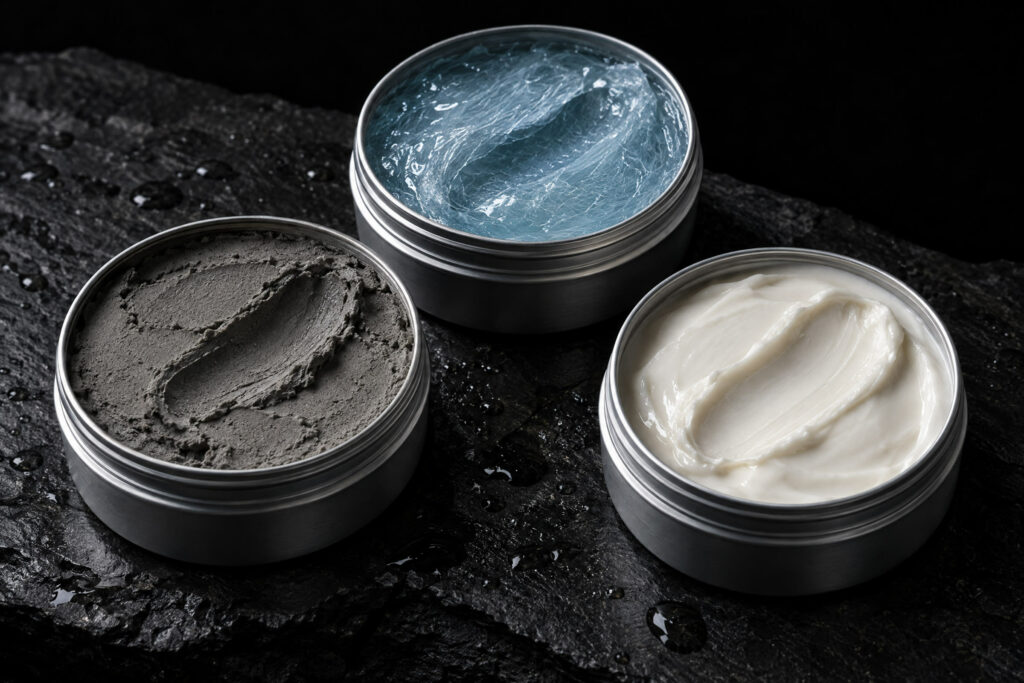
Fibre gum is a hair styler with a stretchy, stringy texture that pulls hair into defined strands. It gives medium, flexible hold and a natural sheen rather than a matte or glossy finish. Use a pea-sized amount, warm and stretch it between your palms, and work it through dry or towel-dried hair for separated, movable texture.
In short
- Fibre gum (also sold as fibre paste or hair gum) is an elastic styler built for texture, separation and movement.
- It sits between clay and wax: more flexible than a matte clay, less shiny than a pomade.
- It suits short to medium cuts, thicker hair and messy or piecey styles that should still move.
- Stretch it between your palms before it touches your hair. That is what creates the strands.
- It is not the same thing as “hair fibres”, which are powders for a fuller look on thinning patches.
What is fibre gum, exactly?
Fibre gum is a styling product whose texture behaves a little like warm chewing gum. Pull your hands apart after rubbing it in your palms and you will see fine threads stretching between your fingers. Those threads are the point. As you work the product through, it coats small groups of hairs and pulls them together into defined pieces, then lets each piece move independently.
That gives you a particular kind of result: hair that looks styled and separated, but not stiff. You can run your fingers through it, push it around later in the day and it will still hold a shape.
You will see it sold under a few names. Fibre paste, styling fibre, hair gum and fibre gum all describe broadly the same family of products. Some lean drier and more matte, some shinier. The defining trait is that stringy, elastic feel.
Fibre gum vs clay vs wax vs pomade: what is the difference?
Every styler is a balance of two things: hold, which is how well hair stays where you put it, and finish, which is how much it shines. Fibre gum earns its place by combining moderate hold with a soft, natural sheen and an unusual amount of flexibility.
| Styler | Typical hold | Finish | Feel in the hand | Best for |
|---|---|---|---|---|
| Fibre gum | Medium, flexible | Natural shine | Elastic, stringy | Separation, movement, messy textured styles |
| Matte clay | Strong | Matte | Dense, dry | Height, structure, fine hair needing body |
| Hair wax | Light to medium | Low to medium shine | Smooth, waxy | Neat, classic shapes |
| Pomade | Medium to strong | High shine | Slick, smooth | Slick backs and side partings |
| Defining cream | Medium to strong, restylable | Soft definition | Creamy | Waves, curls, damp-hair styling |
If you want the detailed version of how the Hollo stylers compare, our guide to matte clay vs fibre gum vs defining cream goes through each one by hair type.
Fibre gum vs clay
Clay gives a firmer, drier, more structured result. It is the better tool for building height and keeping it there. Fibre gum is softer and more mobile. Choose clay if you want a shape that stays put. Choose fibre gum if you want texture that moves when you do.
Fibre gum vs wax
Wax gives a smoother, more uniform finish, which suits tidy, combed styles. Fibre gum breaks hair up into pieces. If your aim is “neat”, wax. If your aim is “deliberately undone”, fibre gum.
Is fibre gum the same as hair fibres?
No, and the names cause real confusion. Products sold as hair fibres, hair building fibres or hair fibre powder are fine coloured powders shaken onto areas where hair is thinning, so the hair looks fuller. They are a cosmetic cover, not a styler, and they give no hold.
Fibre gum is a styling product for shaping hair you already have. If you are searching for one and keep finding the other, that is why. If thinning hair is what is on your mind, your GP is the right first conversation, not a styling product.
Who is fibre gum good for?
Fibre gum is at its best on hair with a bit of length to play with. Very short buzz cuts give it nothing to separate, and very long hair can outgrow its medium hold.
Hair types that suit fibre gum
- Thick or medium-thickness hair. There is enough hair to separate into visible pieces, and the elastic texture spreads evenly through it.
- Straight hair that falls flat. The stringy texture gives straight hair definition it does not have on its own.
- Slightly wavy hair. Fibre gum can emphasise a loose wave without the crunch of a stronger product.
Very fine hair can still use it, but use less and combine it with a pre-styler for lift. Our guide to the best hair products for fine hair explains why heavier, shinier products tend to flatten fine hair.
Cuts and styles that suit fibre gum
- Textured crops where you want visible pieces on top with a little sheen.
- Messy, tousled styles that should look relaxed rather than rigid.
- Soft quiffs and pompadours where you want movement at the front instead of a solid wall.
- Short-to-medium length on top with a fade at the sides, where the contrast makes texture stand out.
If you want maximum height or a hard, matte finish, a strong clay will do the job better. Super Dry Clay gives extra-strong, pliable hold with a matte finish for exactly that kind of structure.
How do you use fibre gum?
The method matters more with fibre gum than with most stylers, because the stretching step is what produces the texture.
- Start with clean hair. Styler applied over yesterday’s product goes on unevenly and looks heavy.
- Dry or towel-dry your hair. Fibre gum works on dry or almost-dry hair. To towel-dry without roughing up the cuticle, the American Academy of Dermatology suggests you wrap hair in a towel to absorb the water rather than rubbing.
- Blow-dry for volume, if you want it. Direct the hair roughly where you want it to end up. The AAD advises using low or medium heat settings and limiting blow-drying.
- Take a small amount. A pea-sized scrape from the tin is plenty for short hair.
- Warm and stretch it. Rub your palms together, then pull them apart a few times until the product is thin and threads form between your hands.
- Apply from the back to the front. Rake your fingers through from the crown forwards, so the most visible area at the front gets the lightest coat.
- Work to the roots, then shape. Use your fingertips to lift and push the hair into rough sections.
- Twist the ends. Take small pieces between your thumb and finger and twist or pinch them. This is where the separation really shows.
Fibre gum on damp hair
Some people apply fibre gum to towel-dried hair and then blow-dry it in for more volume and a softer hold. That is a reasonable approach, but the result tends to be less defined than applying it to fully dry hair. Try both and see which you prefer.
Pairing fibre gum with sea salt spray
For flat or fine hair, a pre-styler gives fibre gum something to grip. Mist Sea Salt Spray through towel-dried hair, blow-dry it in, then finish with a small amount of fibre gum for separation. The spray adds volume and grit; the gum adds definition and a little shine on top.
How much fibre gum should you use?
Less than you expect. Too much fibre gum makes hair clump into thick, greasy-looking ropes instead of fine pieces, which defeats the purpose.
As general guidance:
- Short hair (crop, short sides): a pea-sized amount.
- Medium length on top: a slightly larger amount, around the size of a fingernail.
- Thick hair: start with the medium amount and add a second small scrape only if needed.
Adding more is easy. Taking it out means washing your hair and starting again.
What does Hollo Fibre Gum do?
Hollo Fibre Gum is a medium-hold styler with a natural shine. Its elastic, fibrous texture is designed for texture and separation, so it suits the messy, movable styles described above. It has a bubblegum scent and comes in 50ml and 100ml tins.
Within the range, it sits between the two clays and the cream. The clays give stronger hold and a matte finish. Defining Cream gives strong, restylable hold with definition, and suits waves and curls styled on damp hair. Fibre gum is the one to reach for when you want movement and a bit of sheen rather than structure.
How do you wash out fibre gum?
Fibre gum is designed to stay in through the day, so a quick rinse will not always shift it.
- Apply shampoo to dry or barely damp hair first, focusing on where the product sits. This gives the shampoo a chance to break it down before water dilutes it.
- Massage, then add water and work up a lather.
- Rinse and repeat if your hair still feels coated.
- Condition. The AAD notes that conditioner moisturises and detangles hair and makes it easier to manage.
If you style every day, a regular double shampoo stops product building up and leaving hair dull and heavy.
As with any cosmetic, if a styler leaves your scalp red, itchy or sore, stop using it. The NHS lists cosmetics among the products that can trigger allergic contact dermatitis, and advises you to speak to a pharmacist if it is troubling you, or see a GP if symptoms are persistent or severe.
Frequently asked questions
What does fibre gum do to your hair?
Fibre gum coats small groups of hairs and pulls them into defined strands, giving texture and separation. It offers medium, flexible hold with a natural sheen, so hair keeps its shape but can still move and be restyled with your fingers.
Is fibre gum better than clay?
Neither is better. They do different jobs. Clay gives stronger hold and a matte, structured finish, ideal for height and fine hair that needs body. Fibre gum gives softer, more mobile hold with some shine, suited to messy, separated styles.
Can you use fibre gum on wet hair?
You can apply it to towel-dried hair and blow-dry it in for a softer, more voluminous result. For the clearest separation, though, apply it to dry or almost-dry hair. On soaking-wet hair it tends to lose grip.
Is fibre gum good for short hair?
Yes, as long as there is some length on top to work with. It suits textured crops and short styles with a fade, where it picks out visible pieces. On very short buzz cuts there is little for it to separate.
What is the difference between fibre gum and hair fibres?
Fibre gum is a styling product for shaping and texturing hair. Hair fibres, or hair building fibres, are coloured powders applied to thinning areas so hair looks fuller. They give no hold and are not used for styling.
Find fibre gum alongside the clays, cream and sea salt spray in our hair collection.