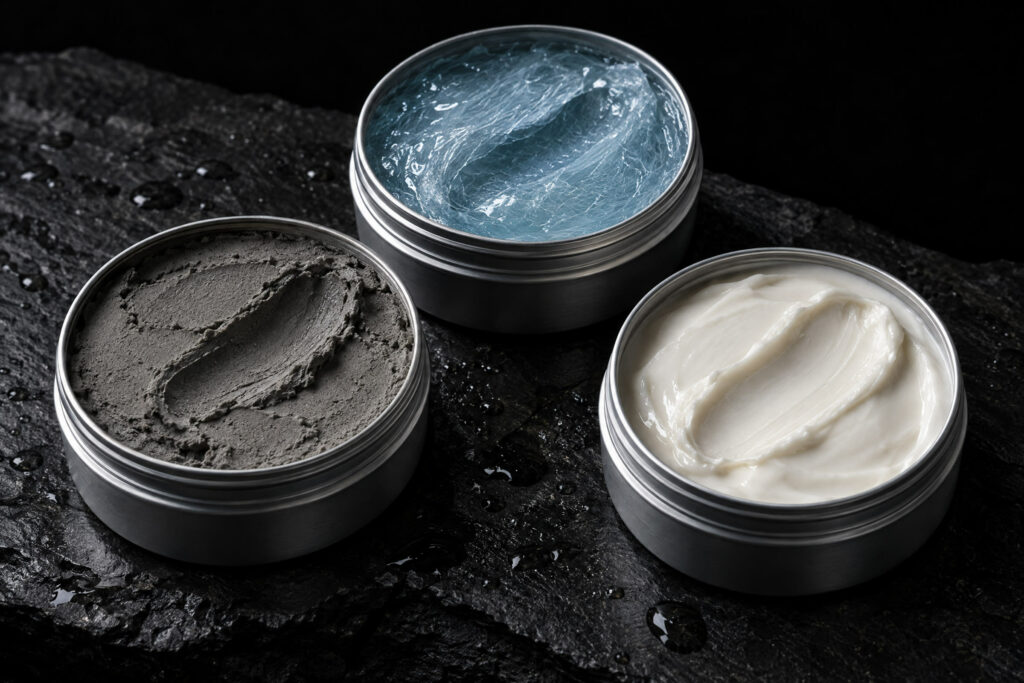
The best hair products for fine hair in men are light, matte and dry: a sea salt spray or similar pre-styler to add grip and volume at the roots, then a small amount of matte clay to hold the shape. Avoid heavy, shiny pomades and gels, which weigh fine hair down. No styling product makes hair thicker, but the right one can make it look noticeably fuller.
In short
- Fine hair means each strand is thin. It is not the same as thinning hair or hair loss.
- Weight is the enemy. Matte, dry products add body; oily, glossy ones flatten.
- A pre-styler such as sea salt spray, blow-dried in at the roots, does most of the work.
- Use less product than you think, and warm it fully in your hands first.
- No product thickens hair or helps with hair loss. If you are worried about thinning, see a GP.
What counts as fine hair?
Fine hair describes the width of each individual strand. It is thinner than average, which makes it softer and lighter, but also quicker to go flat, look greasy and show the scalp when it is cut short.
Fine hair is different from:
- Thin hair, which usually means there are fewer hairs per square centimetre. You can have plenty of fine hairs, or a few thick ones.
- Thinning hair, which means you are losing hair or the hairs are getting finer over time. That is a health question rather than a styling one, covered further down.
Many men have both fine and fairly dense hair. Styling makes the biggest difference there, because the goal is simply to stop the strands lying flat against each other.
Why does fine hair go flat?
Three things work against fine hair.
- Weight. A thin strand cannot support much product. Heavy oils, waxes and gels pull it down.
- Oil. Fine hair has less bulk to spread your scalp’s natural oil across, so it can look greasy faster.
- Smoothness. Smooth, clean hair lies flat and close together, which reads as less hair.
So the products that work tend to do the opposite: they are light, they absorb or avoid shine, and they rough up the surface of the hair slightly so strands sit apart.
Which hair products work best for fine hair?
There is no single product that suits everyone, but there is a clear pattern. Here is how the main types compare for fine hair.
| Product type | Hold | Finish | Weight on fine hair | Verdict for fine hair |
|---|---|---|---|---|
| Sea salt spray | Medium to strong | Matte, textured | Very light | A strong first step for volume |
| Matte clay | Strong | Matte | Light if used sparingly | Usually the most reliable finisher |
| Fibre gum | Medium | Natural shine | Moderate | Good for texture and separation; use a small amount |
| Defining cream | Strong, restylable | Soft definition | Moderate | Better for medium hair or a neater look |
| Pomade | Varies | High shine | Heavy | Usually flattens fine hair |
| Gel | Strong | Wet look | Heavy when set | Can clump fine hair and show the scalp |
Sea salt spray: the foundation
Sea salt spray is a light, water-based pre-styler. It roughens the surface of each strand so hairs sit apart rather than lying flat together, which is why it can make fine hair look thicker. It also gives a finishing product something to grip.
Our Sea Salt Spray gives medium to strong hold with volume and texture, and is good for making fine hair look thicker. It has a coconut and mandarin scent. For the full method, see our guide on how to use sea salt spray.
Matte clay: the finisher
Clay is the usual answer for fine hair because it holds without shine. A matte finish hides the scalp better than a glossy one, and the slightly gritty texture bulks out each strand.
- Dry Matte Clay gives strong hold and a natural matte finish, with a lemon and melon scent. It is the one to try first for most fine hair.
- Super Dry Clay gives extra-strong hold with a matte, pliable finish, with a strawberry scent. It suits short, textured crops where you want the style to stay put.
Fibre gum and defining cream: use with care
Neither is wrong for fine hair, but both carry a little more weight and sheen than a clay.
- Fibre Gum has an elastic, fibrous texture that is good for separation and messy texture, with medium hold and natural shine. On fine hair, use a very small amount and focus it on the ends.
- Defining Cream gives strong, restylable hold with definition and texture. It can work for a neater side parting on fine hair, but tends to suit medium to thick hair best.
Our comparison of matte clay vs fibre gum vs defining cream goes into hold and finish in more detail.
How to style fine hair for more volume
The method matters as much as the product. This routine works for most short and medium cuts.
- Start with clean, towel-dried hair. Fine hair holds volume better when it is not weighed down by yesterday’s product.
- Apply sea salt spray to damp hair. A few sprays, focused at the roots, especially on the crown and fringe.
- Blow-dry upwards and against the direction it falls. Lift at the roots with your fingers or a brush. Use a low or medium heat setting.
- Let the hair cool before styling. It holds its shape better once it has set.
- Take a small amount of clay. Roughly a fingertip, less than you think.
- Warm it fully between your palms until it is almost invisible. Unwarmed clay leaves clumps.
- Work it in from the back forwards, from the roots up, rather than plastering it on top.
- Shape with your fingertips. Twist and pinch small sections for texture. Add more only if you need it.
The American Academy of Dermatology recommends that you limit blow-drying and use low or medium heat settings. A quick, cool-to-warm blow-dry is enough to set volume; you do not need to blast it.
What should men with fine hair avoid?
- Too much product. The most common mistake. Overloading makes fine hair clump, separate at the scalp and look thinner.
- High-shine pomades and heavy gels. Shine reflects light off the scalp and makes hair look sparser.
- Conditioner on the roots. The AAD suggests that people with fine hair apply conditioner to the ends rather than the whole length.
- Very hot heat styling, every day. It dries hair out, which makes it harder to style.
- Styling flat against the head. Combing fine hair down and smooth emphasises every gap.
Shampoo and conditioner for fine hair
Your wash routine sets up the style. Fine hair often benefits from more frequent washing, because oil shows quickly. The AAD notes that people with straight hair and an oily scalp may want to shampoo every day, and recommends applying shampoo to the scalp rather than the full length of the hair.
A light daily shampoo and conditioner pairing works well. Our Tea Tree Shampoo cleanses and leaves the scalp feeling refreshed, and the matching Tea Tree Conditioner detangles, softens and smooths. On fine hair, keep the conditioner to the mid-lengths and ends.
Can hair products make thin hair thicker?
No. This is worth being clear about. Styling products change how hair looks and holds, not how many hairs you have or how thick each strand is. A matte clay or sea salt spray can make fine hair look fuller because the strands sit apart and the scalp is less visible. Wash it out, and your hair is exactly as it was.
The same goes for thinning hair. No shampoo, clay, spray or conditioner, ours included, stops hair loss or regrows hair. The British Association of Dermatologists’ leaflet on male pattern hair loss describes it as the most common type of hair loss in men, and lists the medical options separately from cosmetic camouflage such as fibre sprays and hairpieces.
When to see a GP about thinning hair
Some hair loss is simply part of getting older, and the NHS notes that male pattern baldness usually runs in families. But if you are worried about your hair, a GP is the right first step. The NHS advises that you see a GP if you are worried about your hair loss, and to get an idea of what is causing it before thinking about going to a commercial hair clinic.
It is also worth mentioning to a GP if your hair is coming out in patches or clumps, or if your scalp is sore or irritated, rather than trying to fix it with styling products.
Frequently asked questions
Is clay or paste better for fine hair?
For most fine hair, a matte clay is the safer choice. It holds without shine and adds a little grit, so hair looks fuller. Pastes and creams vary a lot; the lighter, more matte ones can work, but anything glossy or heavy tends to flatten fine hair.
Does sea salt spray make hair thicker?
It does not change the hair itself, but it can make fine hair look thicker. The salt roughens the surface of each strand so they sit apart instead of lying flat together. Blow-drying it in at the roots gives the biggest effect.
How much hair product should I use on fine hair?
Start with roughly a fingertip of clay for short hair and warm it fully in your palms before applying. You can always add a little more. Too much product is the quickest way to make fine hair look greasy, clumped and thinner.
Should men with fine hair use conditioner?
Yes, but lightly. Conditioner helps with tangles and manageability. On fine hair, apply it to the ends rather than the roots, and rinse it out well so it does not weigh the hair down.
What haircut suits fine hair?
Shorter, textured cuts such as crops and short quiffs usually work well, because short hair is lighter and holds volume more easily. Ask your barber for texture rather than blunt, heavy lines, and style with a matte product. Very long, flat styles tend to show fine hair at its thinnest.
Light, matte stylers and pre-stylers for every hair type are in our hair range.