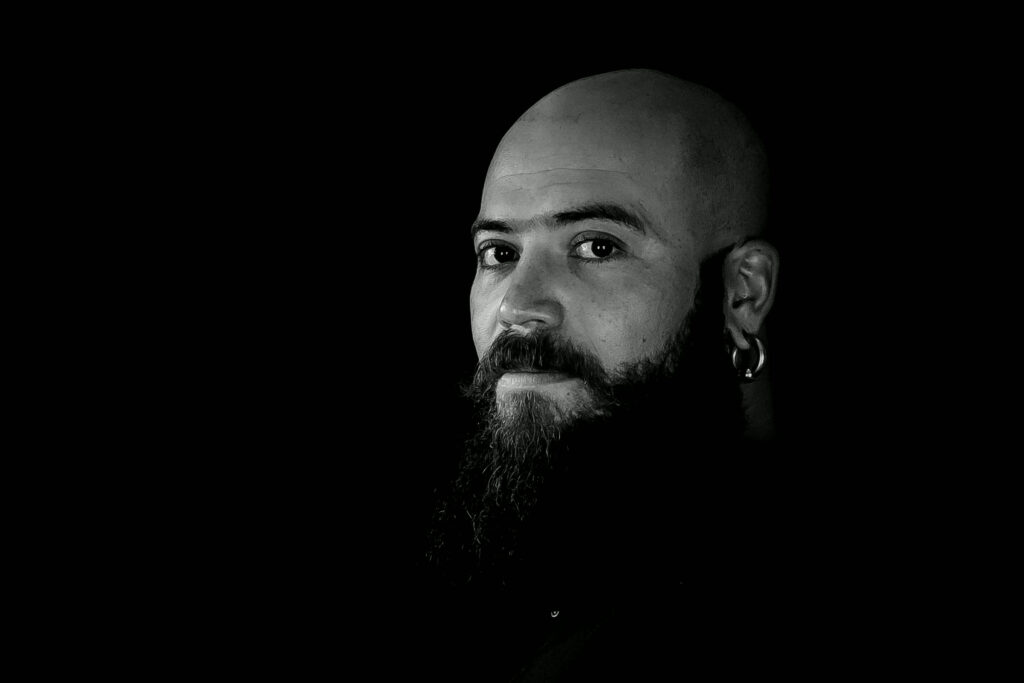
To trim a beard at home, start with a clean, dry, combed-out beard and a trimmer set to a longer guard than you think you need. Trim the bulk with the grain, then set a neckline about two fingers above your Adam’s apple, tidy the cheek line, and finish the moustache with scissors. Go one guard size at a time. You can always take more off.
In short
- Trim dry, not wet. Wet hair looks longer than it is, so you end up cutting too much.
- Always start with a longer guard and work down. Taking off more is easy; putting it back takes weeks.
- The neckline sits roughly two fingers above your Adam’s apple. Too high is the most common mistake.
- Leave the natural cheek line alone if it looks tidy. Only clean up the strays below it.
- Finish with beard oil to soften freshly cut ends and moisturise the skin.
What do you need to trim a beard at home?
You do not need a barber’s kit. Four things cover almost every beard.
- A trimmer with a set of guards. Guards (the plastic combs that clip over the blade) set the length you leave behind. A good range of guard sizes matters more than the brand.
- Small, sharp scissors. For the moustache, stray hairs and the ends of longer beards. Proper beard or hair scissors, not kitchen scissors.
- A fine-tooth comb. For lifting hairs and checking length. A wide-tooth comb is useful too for longer beards.
- A mirror and good light. Ideally a second mirror, or your phone camera, for checking the neckline from the side.
The American Academy of Dermatology suggests trimming with an electric razor, or with scissors for longer facial hair, and keeping the skin underneath moisturised. That combination, rather than any particular gadget, is what keeps a trimmed beard looking good.
Should you trim your beard wet or dry?
Dry. Wet hair hangs straighter and looks longer than it really is. Trim it wet and, once it dries and springs back, you will find you have cut more than you meant to. Curly and coarse beards shrink the most.
The best time is after a wash, once the beard is fully dry and combed through. Clean hair cuts more evenly, and combing it out first shows you the true length and any uneven patches.
Beard trimmer guard lengths by style
Guard numbers vary between brands, so think in millimetres rather than numbers. This table is general guidance for common styles, not a fixed rule. Hair density, growth pattern and face shape all change what looks right.
| Style | Typical guard length | Notes |
|---|---|---|
| Light stubble | 1–3mm | Trim every few days to keep it crisp |
| Heavy stubble | 3–5mm | Looks deliberate rather than forgotten |
| Short boxed beard | 5–10mm | A neat, office-friendly shape |
| Medium beard | 10–20mm | Shorter on the cheeks, longer on the chin |
| Full beard | 20mm and over, or scissors | Trim the shape rather than the length |
| Neckline and edges | No guard or 1–2mm | Detail work only |
Two tips that make the difference:
- Fade the sides. Most beards look better slightly shorter on the cheeks and slightly fuller at the chin. Go one guard size down on the cheeks and sideburns.
- Start one size longer. If you think you want 10mm, start at 12mm and step down after you have seen it.
How to trim a beard: step by step
This is the order a barber would follow. It keeps you from cutting the outline before you know where the bulk is sitting.
- Wash and dry the beard. A gentle beard wash such as our Beard Shampoo, then towel-dry and leave it to dry fully.
- Comb it out. Comb downwards and outwards so every hair is standing at its real length.
- Choose your guard and trim the bulk. Start with a longer guard. Move the trimmer with the direction of growth, in slow, overlapping strokes, cheeks first, then chin and jaw.
- Check for symmetry. Look straight on, then from each side. Comb out again and repeat with the same guard to catch anything missed.
- Fade the sides if you want to. Drop one guard size and trim the sideburns and upper cheeks, blending into the longer hair at the jaw.
- Set the neckline. See the next section. Remove the guard, or use the shortest one, for this.
- Tidy the cheek line. Only remove the strays that sit below your natural line.
- Trim the moustache. Comb it down over the lip and trim along the lip line with scissors.
- Snip the strays. Comb through once more and catch anything sticking out with scissors.
- Rinse and moisturise. Rinse off loose hair, pat dry and work in a few drops of beard oil.
How do you trim a beard neckline?
A good neckline does more for a beard than almost anything else. A bad one, usually set too high, can make a full beard look like a chinstrap.
The simple rule: place two fingers flat above your Adam’s apple. The top of those fingers is roughly where the neckline should sit.
- Mark the centre point. Two fingers above the Adam’s apple.
- Picture a curve. Imagine a line running from that point back towards each earlobe, curving up just behind the angle of the jaw.
- Shave or trim everything below the line. Use the trimmer without a guard, working from the neck upwards to the line.
- Work from the centre out. Do the middle first, then each side, checking both match.
- Soften the edge. For a more natural look, use a short guard to blend the hair just above the line rather than leaving a hard step.
If in doubt, set it a little lower. You can always raise it next time.
If you also shave your neck, the NHS suggests that leaving at least 1mm of stubble and using an electric razor rather than wet shaving can help reduce ingrown hairs. Trimming the neck very short, rather than shaving it bare, is a sensible option if you are prone to them.
How to tidy the cheek line
Most men’s natural cheek line looks better than anything they would draw. The aim is tidying, not reshaping.
- Look for the natural line where dense growth thins out.
- Remove only the scattered hairs above and below it.
- Use the trimmer without a guard, held flat, in short downward strokes.
- Do one side, then match the other. Small adjustments, check, repeat.
Lowering the cheek line too far makes a beard look thinner and narrower. If you are unsure, leave it.
How to trim a moustache
The moustache is the part people see first, and the easiest to overdo.
- Comb it straight down over the top lip.
- Trim along the lip line with scissors, a little at a time, following the natural shape of your lip.
- Trim the bulk with a trimmer and a short guard if it is getting heavy.
- Check the corners. Decide whether you want the ends to stop at the corners of your mouth or run into the beard, and keep both sides even.
If you prefer the ends trained rather than trimmed, a little Moustache Wax holds them in shape. It is made with real beeswax, gives a reworkable medium hold, and comes in our Century scent.
How often should you trim your beard?
There is no single answer, because it depends on how fast you grow and how sharp you want the edges.
| Beard type | Bulk trim | Neckline and cheeks |
|---|---|---|
| Stubble | Every few days | Every few days |
| Short beard | Every week or two | Weekly |
| Medium or full beard | Every few weeks | Weekly or as needed |
| Growing it out | Rarely, just the shape | As needed to stay tidy |
If you are growing a beard longer, resist the urge to trim the length at all for a while. Keep the neckline and cheeks clean, and let the rest catch up. Tidy edges make an in-between beard look intentional.
Beard aftercare: what to do after trimming
Fresh trimmer work leaves cut ends that can feel sharp, and the skin along the neckline can feel a little raw. A minute of aftercare sorts both.
- Rinse off loose hairs. Cut hair left on the skin itches.
- Moisturise. A few drops of Beard Oil softens the freshly cut ends and moisturises the skin underneath. Ours pairs hemp oil for the skin with jojoba oil for the hair, in Century or Willow.
- Shape if you need hold. Fuller and longer beards can be tamed with Beard Wax, made with cocoa butter and jojoba oil for a soft hold.
- Leave the neck alone. If the skin along the neckline feels sensitive, avoid scented products there for the rest of the day.
If itching flares up as your beard grows between trims, our guide on how to stop beard itch covers the washing and moisturising habits that help. For how oil, balm and wax differ, see beard oil vs beard balm vs beard wax.
Common beard trimming mistakes
- Trimming wet. The beard springs back shorter than you planned.
- Starting with a short guard. Always start long.
- Setting the neckline too high. Two fingers above the Adam’s apple, not along the jawbone.
- Lowering the cheek line. It rarely looks better than your natural line.
- Rushing the moustache with the trimmer. Scissors give far more control on the lip line.
- Trimming tired, or in bad light. Small mistakes are easy to make and slow to grow back.
Frequently asked questions
Where should my beard neckline be?
For most people, about two fingers above the Adam’s apple, curving back towards the earlobes just behind the angle of the jaw. Setting it along the jawbone is the most common mistake and makes the beard look thinner. If in doubt, go slightly lower.
What number guard should I use to trim my beard?
Guard numbers vary by brand, so check the millimetre length. As general guidance, 1–3mm suits light stubble, 3–5mm heavy stubble, 5–10mm a short beard and 10–20mm a medium beard. Start one size longer than you think you want and work down.
Should I trim my beard before or after a shower?
After, once it is fully dry. Wash and dry the beard first so it is clean and combs out evenly, then trim. Trimming a wet beard usually means cutting off more than you intended.
Can I use scissors instead of a trimmer?
Yes, especially for longer beards and the moustache. Comb the hair out and trim small amounts at a time, checking symmetry as you go. A trimmer is easier for even, short lengths and for setting the neckline.
How do I make my beard look fuller after trimming?
Keep the sides slightly shorter than the chin, set the neckline a little lower, and leave the natural cheek line alone. Conditioning the hair with beard oil helps it lie neatly so it looks fuller. No product makes a beard grow, but a good shape makes the most of what you have.
A sharp trim deserves good aftercare, and everything for washing, softening and shaping is in our beard care range.